

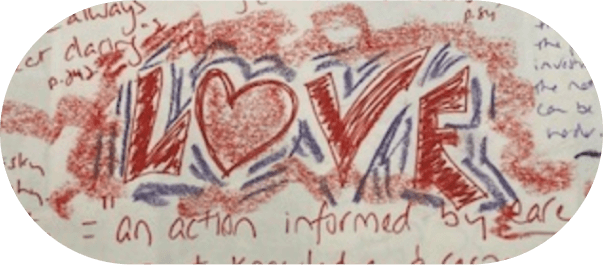
CARE begins when survivors are placed at the center.
 FOR HELP, 24/7: NATIONAL SEXUAL ASSAULT HOTLINE (800-656-HOPE); ONLINE CHAT (ONLINE.RAINN.ORG); VISIT NATIONAL SEXUAL VIOLENCE RESOURCE CENTER (NSVRC)
FOR HELP, 24/7: NATIONAL SEXUAL ASSAULT HOTLINE (800-656-HOPE); ONLINE CHAT (ONLINE.RAINN.ORG); VISIT NATIONAL SEXUAL VIOLENCE RESOURCE CENTER (NSVRC)

To begin, it’s worthwhile to reflect on our identity as it exists in relation to the d-HARM-a we’ve experienced, as “words are the medium through which belief systems are manufactured, nurtured, and reinforced.” (AMANDA MONTELL, CULTISH)
Diane Shainberg, a psychotherapist who has dealt with many such cases [of Tibetan teachers having sexual relationships with their students], was askid if these relationships could ever be described as ‘transcendental’. She replied:
‘Never. In each and every case, the woman was not able to make sense out of it, and…was not in touch with her own needs and wants. She had gone to the figure of authority to validate her, and it had not happened. She was turned into a sexual object and she ultimately felt that she had been abandoned, not only by the authority figure, the spiritual teacher, but by the sangha…and finally, abandoned by herself…’ “
In the face of an array of structural forces – institutional, legal, and cultural – that routinely silence, shame, blame, and marginalize survivors of Buddhist sexual violence, we realized that survivor testimony must be actively sought and given special weight and attention in order to prevent it from disappearing.”
[A] feminist survivor-centered approach, [which] prioritizes relationality, care and empathy.”
Survivor-centered approaches ‘actively center the perspectives and needs of survivors of sexual violence. As a feminist approach, this reframing critically addresses and dismantles the hierarchies of knowledge and truth that tend to structure how we think about and research sexual violence.’ “
We also explore the implications of a survivor-centered methodology for Buddhist Studies, arguing that only when Buddhist Studies scholars push against normative disciplinary formations to listen for and to marginal Buddhist voices will our scholarship cease to reinscribe normative Buddhist constellations of power – the same dynamics that tolerate and engender abuse.”
[I]t is only by making women’s well-being central that we can explode this myth: that speaking out, immediately and in public, is the only authentic form of agency. Quiet endurance, confiding in one trusted person, practicing a healing ritual — all of these can be part of how people begin to move forward.”
A person-centered approach respects each meditator’s definitions of well-being and harm, and their personal goals for practice. It’s a central part of a trauma-informed approach, which helps support a sense of empowerment, agency, and autonomy.
It can be as simple as offering options.”
[So many women] gave me incredible strength….And I thanked them for it…I [also] received thousands of letters from all over the world…and [these women] thanked me for talking about [my abuse] because now they were no longer afraid to do it as well. I got so many messages from women telling me, ‘thanks to you, I’m going to file a complaint.’ “
First of all, don’t lose your self-confidence. Listen to that voice that takes you in the right direction. I had doubts, everybody has doubts, I had doubts at times. But I would tell [other survivors]: don’t have shame, don’t be ashamed, don’t be afraid, confront your aggressor. We all have a force, we all have a strength inside that we can use to help us stride forward. Keep your eyes on the future, look ahead. Look ahead and stand tall in your dignity.”
In our ethnographic research on sexual abuse and misconduct in contemporary Buddhism, we found that survivors of abuse were routinely dismissed, vilified, and silenced when they attempted to speak out about their experience.”


In many dharma centers, a culture of silence has allowed abuse to be perpetuated for far too long. I firmly believe that to effect meaningful change, we must discuss these issues openly and constructively.
• Mariana Restrepo
I have had the advantage of being on meditation retreats in both India and Thailand, and I noticed a major difference: in the west there was always a very palpable avoidance of any strong emotions. We were told to “sit with it” which meant never express it, and talking with an instructor was always invalidating. It essentially taught dissociation.
• anonymous
As a survivor of harm in an institution with a long and recorded history of abuse, I become outraged seeing that they – and many other centers – don’t acknowledge this history on their current sites! How could they ever be considered trustworthy, by that fact alone?!
• a survivor
[T]he list of implicated centers could actually be much longer. There is scarcely a Tibetan Buddhist community without some kind of scandal associated.
• beaudega1 (Reddit)
As you may know, Sogyal [Lakar] was by far the most egregious abuser in modern Buddhist history. Another dam burst of evidence of extreme abuse, denial and obfuscation is about to burst about [REDACTED], its offshoots and its Charity [REDACTED]. Long overdue. I am in touch with survivors.
• anonymous
It never occurred to me to leave my cult. I wasn’t thinking of leaving, I was accepting the behaviors and situations I was put in as being the norm and the reality of my new existence, which I was groomed into thinking was a higher existence
• Rachel Montgomery, Healing and Justice podcast
The other people in the organisation would not do anything when I complained about how [the main teacher] had bullied me. I complained for two years whilst it was happening and afterwards, but there was no procedure for safe guarding or complaints. Since then I have learned of terrible sexual abuse by the main teachers and rapes by one of the residents.
• Sarah L.
It really seems like care is very person-centered, and operates outside of most of the ideological & doctrinal frameworks instituted by Buddhism.
• anonymous
Thank you! I feel seen. I lost my Sangha, my lifeline, and I’m taking deep breaths after two years of quiet shame.
I’m thankful I wasn’t personally touched but I was emotionally very much touched.
• anonymous
